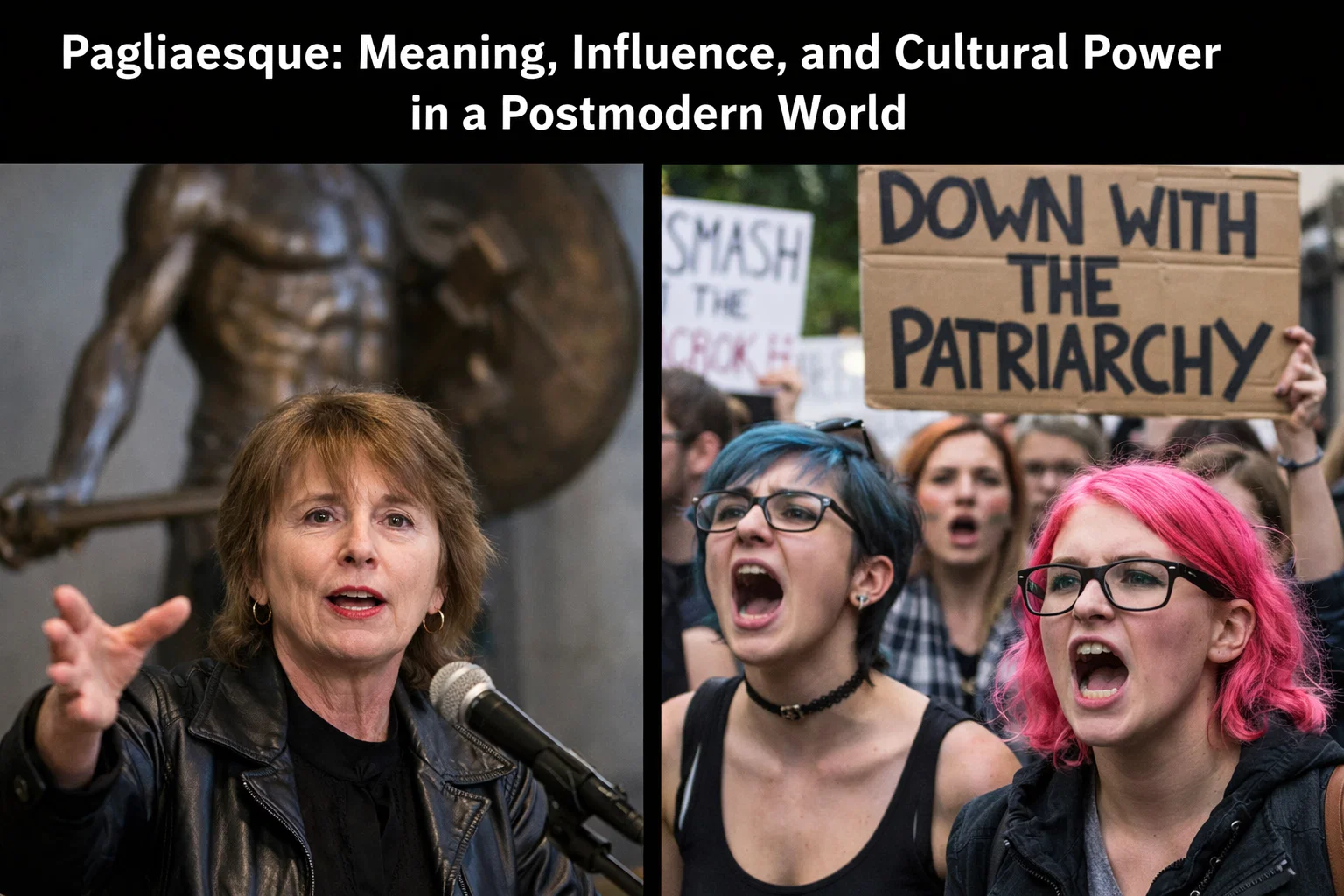
To describe something as pagliaesque is to invoke a particular kind of intellectual electricity. The term signals provocation without apology, scholarship without timidity, and cultural analysis that refuses to flatter prevailing orthodoxies. It is not merely a stylistic adjective but a shorthand for a worldview—one that blends art history, sexuality, mythology, and pop culture into a single, confrontational lens.
In an era shaped by algorithmic consensus and reputational risk management, the pagliaesque stands apart. It prizes clarity over comfort and insight over social approval. This article explores the meaning, origins, applications, and enduring relevance of pagliaesque thinking, positioning it as a vital interpretive framework for understanding culture, power, and human nature today.
Defining Pagliaesque as an Intellectual Style
At its core, pagliaesque describes an approach to ideas that is fiercely interdisciplinary and unapologetically assertive. It combines aesthetic criticism, biological realism, and historical depth, often delivered with rhetorical intensity and moral confidence. The term suggests a refusal to dilute arguments for the sake of politeness or ideological alignment.
What makes pagliaesque analysis distinctive is its insistence on grounding cultural interpretation in long historical arcs rather than short-term political narratives. Instead of treating art, gender, or sexuality as purely social constructs, it frames them as expressions of enduring human drives shaped by nature, tradition, and symbolic inheritance.
The Origins of the Pagliaesque Label
The adjective derives from the work and public persona of Camille Paglia, whose writings in the late twentieth century challenged academic feminism and postmodern literary theory. Her unapologetic style and willingness to critique allies as harshly as opponents made her both influential and controversial.
Over time, readers and critics began using pagliaesque to describe not only her own work but also a broader mode of cultural engagement. The label evolved into a conceptual shorthand for arguments that combine classical learning, sexual frankness, and disdain for intellectual conformity.
Core Characteristics of Pagliaesque Thinking
Pagliaesque thinking is defined by its synthesis rather than specialization. It draws freely from art history, anthropology, psychology, and classical literature, treating culture as an ecosystem rather than a collection of isolated texts. This holistic approach allows it to identify patterns that narrower frameworks often miss.
Equally important is tone. Pagliaesque arguments are delivered with confidence bordering on theatricality. The voice is declarative, not tentative, and it assumes that truth is something to be asserted clearly rather than negotiated endlessly through disclaimers.
Pagliaesque and the Rejection of Academic Orthodoxy
One of the most recognizable elements of pagliaesque discourse is its skepticism toward institutional consensus. It questions whether dominant academic narratives truly reflect reality or merely reinforce internal power structures within universities and cultural organizations.
This skepticism is not anti-intellectual. On the contrary, it demands higher standards of evidence and historical awareness. Pagliaesque critique often argues that contemporary theory has become disconnected from the material realities of biology, artistic tradition, and human psychology.
Sexuality and the Pagliaesque Perspective
Sexuality occupies a central place in pagliaesque analysis, not as a political identity but as a primal force. Desire is treated as unruly, often dangerous, and resistant to moral regulation. This stands in contrast to frameworks that emphasize sexual expression primarily as a site of social justice.
From a pagliaesque viewpoint, attempts to sanitize or bureaucratize sexuality misunderstand its nature. Erotic energy is seen as a driver of art, conflict, and creativity, linking modern culture to ancient mythological patterns rather than contemporary policy debates.
Art History as the Backbone of Pagliaesque Analysis
Unlike many modern cultural critiques, pagliaesque writing places art history at the center of interpretation. Paintings, sculptures, and architectural forms are treated as repositories of psychological and sexual symbolism accumulated over centuries.
This emphasis allows pagliaesque thinkers to draw connections between Renaissance iconography, modern cinema, and contemporary fashion. Culture becomes a continuous conversation across time, not a series of disconnected moments defined solely by present concerns.
Pagliaesque Language and Rhetorical Style
Language in pagliaesque writing is vivid, polemical, and often deliberately provocative. Metaphors are bold, sentences are declarative, and ambiguity is minimized. The goal is not to invite endless debate but to force readers to confront uncomfortable ideas.
This rhetorical style contributes to both the appeal and the controversy of pagliaesque work. Supporters see it as refreshing honesty, while critics perceive it as abrasive or insufficiently nuanced. Either way, it commands attention.
Pagliaesque Versus Postmodern Relativism
A defining contrast lies between pagliaesque thought and postmodern relativism. Where postmodernism emphasizes indeterminacy and the instability of meaning, pagliaesque analysis insists that certain truths persist across cultures and eras.
This does not mean rejecting complexity. Rather, it means acknowledging limits to interpretive flexibility. Human nature, biological sex, and aesthetic hierarchies are treated as real constraints, not mere linguistic constructions.
The Role of Myth in Pagliaesque Interpretation
Mythology is a recurring reference point in pagliaesque analysis. Ancient gods, heroic archetypes, and tragic narratives are used to illuminate modern cultural phenomena, from celebrity culture to political spectacle.
By framing contemporary issues through myth, pagliaesque thinkers argue that modern society is less novel than it believes. The same forces that shaped ancient civilizations continue to operate beneath the surface of digital culture.
Pagliaesque Feminism Explained
Pagliaesque feminism diverges sharply from mainstream academic feminism. It emphasizes individual agency, erotic power, and biological difference rather than systemic victimhood. Women are portrayed as complex actors capable of both vulnerability and dominance.
This approach has attracted criticism for downplaying structural inequalities. Supporters counter that pagliaesque feminism restores a sense of strength and realism that is often missing from purely sociological models.
Pagliaesque Thought in Popular Culture
Beyond academia, pagliaesque ideas have influenced commentary on film, music, and celebrity. Critics adopting this lens analyze pop icons as modern mythic figures shaped by sex appeal, spectacle, and cultural longing.
This perspective treats popular culture seriously without romanticizing it. Mass entertainment becomes a window into collective psychology rather than a distraction from “serious” art.
Media Controversy and the Pagliaesque Persona
Public engagement is another hallmark of the pagliaesque. Media appearances, debates, and interviews are treated as arenas for intellectual combat rather than opportunities for brand management.
This confrontational posture often amplifies controversy but also ensures visibility. The pagliaesque figure accepts misunderstanding as the cost of speaking plainly in a mediated culture.
Pagliaesque Ideas and Free Speech
Free expression is a recurring concern in pagliaesque discourse. Restrictions on speech are viewed as symptoms of cultural insecurity rather than moral progress. Open debate, even when uncomfortable, is framed as essential to intellectual vitality.
From this standpoint, censorship weakens culture by insulating ideas from challenge. The pagliaesque commitment to speech is rooted in confidence that truth emerges through conflict, not consensus.
Pagliaesque Analysis in Gender Debates
Gender debates often reveal the sharpest edge of pagliaesque thinking. Biological sex is treated as a material reality with cultural consequences, not a negotiable concept. This position places pagliaesque voices at odds with dominant gender theories.
The argument is not that culture plays no role, but that it operates within biological parameters. Ignoring those parameters, pagliaesque critics argue, leads to theoretical incoherence and policy confusion.
Pagliaesque Versus Intersectional Frameworks
Intersectionality emphasizes overlapping systems of oppression, while pagliaesque analysis emphasizes individual psychology and historical continuity. The two frameworks often talk past each other, prioritizing different explanatory levels.
Pagliaesque critics argue that intersectionality risks reducing human beings to demographic categories. In contrast, pagliaesque thought insists on personality, desire, and artistic impulse as irreducible factors.
Pagliaesque Writing and Narrative Confidence
Narrative confidence is a defining feature of pagliaesque prose. Arguments are presented as coherent stories with clear protagonists, antagonists, and stakes. This narrative clarity enhances reader engagement.
In an information environment saturated with qualifiers, the pagliaesque willingness to tell a strong story feels both risky and compelling. It invites agreement or rejection, but rarely indifference.
A Comparative Framework: Pagliaesque Versus Other Styles
The table below highlights how pagliaesque analysis compares to other dominant cultural frameworks in terms of method, tone, and assumptions.
| Framework | Primary Focus | Tone | View of Human Nature |
| Pagliaesque | Art, biology, myth | Assertive, polemical | Driven by enduring instincts |
| Postmodern | Language, power | Skeptical, ironic | Socially constructed |
| Intersectional | Identity systems | Analytical, activist | Structurally constrained |
| Formalist | Textual features | Neutral, technical | Largely abstracted |
This comparison underscores why pagliaesque thought resists easy categorization. It operates on different assumptions about what ultimately shapes culture.
Misconceptions About the Pagliaesque Approach
A common misconception is that pagliaesque analysis is purely contrarian. In reality, its disagreements stem from foundational differences about human nature, not a desire to provoke for its own sake.
Another misunderstanding is that pagliaesque thought rejects empathy. On the contrary, it often emphasizes tragic awareness—recognizing human limitations and contradictions rather than promising utopian solutions.
Pagliaesque Influence on Cultural Criticism
Many contemporary critics adopt pagliaesque elements without the label. These include bold cross-disciplinary references, emphasis on aesthetics, and skepticism toward ideological conformity.
This influence suggests that pagliaesque thinking fulfills a need unmet by more cautious approaches. It provides a vocabulary for discussing culture that feels both intellectually grounded and emotionally resonant.
Pagliaesque Thought in the Digital Age
The internet has amplified both the reach and the backlash surrounding pagliaesque ideas. Short-form platforms reward provocation, while long-form analysis struggles for attention.
Yet the pagliaesque commitment to depth and history may be uniquely valuable in a fast-moving media environment. It offers a counterweight to trend-driven discourse by insisting on longer temporal horizons.
The Emotional Appeal of Pagliaesque Writing
Beyond arguments, pagliaesque writing appeals emotionally. Its confidence reassures readers who feel alienated by academic jargon or moralistic rhetoric.
This emotional resonance helps explain why pagliaesque ideas persist despite controversy. They speak to a desire for meaning rooted in tradition and human reality rather than abstract theory.
Pagliaesque as a Cultural Diagnostic Tool
As a diagnostic tool, pagliaesque analysis identifies cultural pathologies by tracing their symbolic origins. Moral panics, celebrity scandals, and ideological shifts are interpreted as expressions of deeper anxieties.
This diagnostic function positions pagliaesque thought as descriptive rather than prescriptive. It seeks to understand before attempting to reform.
A Defining Pagliaesque Quote
One frequently cited sentiment that captures the pagliaesque ethos is:
“Culture is not a therapy session; it is a battleground of instincts, symbols, and power.”
This statement encapsulates the refusal to sentimentalize culture and the insistence on confronting its darker energies directly.
Pagliaesque Criticism and Ethical Responsibility
Critics often ask whether pagliaesque bluntness risks harm. Supporters respond that ethical responsibility lies in truth-telling, not emotional cushioning.
From this view, shielding audiences from difficult realities ultimately undermines their agency. Pagliaesque ethics prioritize intellectual honesty over reputational safety.
Pagliaesque Perspectives on Education
In education, pagliaesque thought favors rigorous engagement with classical texts and visual art. It challenges curricula that prioritize ideological comfort over intellectual challenge.
The goal is not nostalgia but continuity. Education, in this framework, transmits hard-won insights about human nature across generations.
Pagliaesque and the Question of Elitism
Some accuse pagliaesque thinking of elitism due to its reliance on classical references. Proponents counter that the tradition it draws from belongs to everyone, not an academic elite.
By translating complex ideas into vivid language, pagliaesque writing arguably democratizes access to cultural literacy rather than restricting it.
The Future Relevance of Pagliaesque Ideas
As cultural debates intensify, the pagliaesque insistence on foundational questions may become more relevant, not less. Issues of sex, art, and power are unlikely to disappear.
Whether embraced or resisted, pagliaesque analysis provides a durable framework for engaging these debates without reducing them to slogans.
How to Read Pagliaesque Texts Critically
Engaging pagliaesque work critically requires separating tone from substance. Readers benefit from evaluating evidence and historical references independently of rhetorical force.
This approach allows appreciation of insight without uncritical acceptance. Pagliaesque writing invites challenge as much as agreement.
Pagliaesque and Intellectual Courage
Intellectual courage is central to the pagliaesque identity. The willingness to articulate unpopular views is treated as a professional obligation rather than a personal risk.
This courage reinforces the perception of authenticity, a quality increasingly rare in managed public discourse.
Cultural Longevity of the Pagliaesque Mode
The longevity of pagliaesque thinking depends on its adaptability. While specific controversies fade, the underlying method—integrating art, biology, and myth—remains applicable.
This adaptability suggests that pagliaesque is less a moment than a mode, capable of reemerging in different cultural contexts.
Conclusion: Why Pagliaesque Still Matters
To call an idea pagliaesque is to recognize its refusal to compromise with intellectual fashion. It signals a commitment to depth, history, and human complexity in a culture often driven by immediacy.
Whether one agrees or disagrees with its conclusions, pagliaesque thinking offers a powerful reminder that culture is shaped by forces older and more persistent than any single ideology.
Frequently Asked Questions
What does pagliaesque mean in simple terms?
Pagliaesque refers to a bold, interdisciplinary style of cultural analysis that emphasizes art, biology, and history while rejecting ideological conformity.
Is pagliaesque thinking inherently controversial?
Yes, pagliaesque arguments often challenge dominant narratives, which makes them controversial, but the controversy stems from substance rather than provocation alone.
Can someone other than Camille Paglia be described as pagliaesque?
Absolutely. Writers, critics, or thinkers who adopt similar methods and tone can be described as pagliaesque even if they differ in specific views.
Is pagliaesque analysis anti-feminist?
Pagliaesque feminism differs from mainstream feminism but is not anti-feminist; it emphasizes agency, realism, and sexual power rather than victimhood.
Why is pagliaesque writing still relevant today?
In a climate of ideological polarization, pagliaesque writing remains relevant because it addresses enduring human questions with historical depth and intellectual courage.
You may also read
